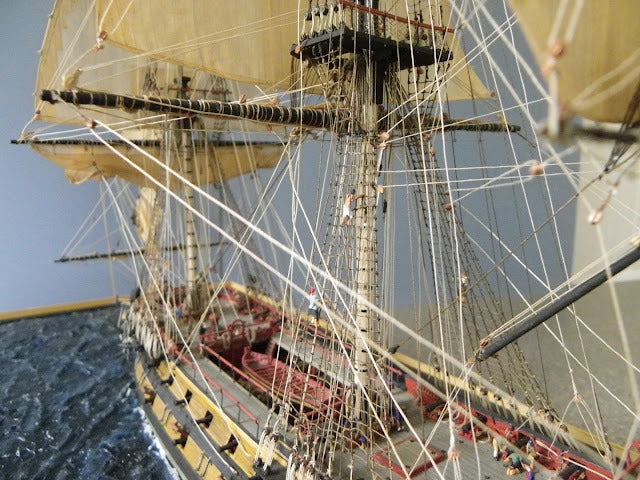


Heller 80895 - Le Superbe 1:150
Heller 80895 - Le Superbe 1:150
SKU:HEL80895
Regular price
$79.99 USD
Regular price
$159.99 USD
Sale price
$79.99 USD
Unit price
per
Shipping calculated at checkout.
Couldn't load pickup availability
Product features
Product features
Heller’s 1:150 scale Le Superbe recreates one of the finest examples of the type in 867 parts. With two full gun decks, 74 cannon, a copper-sheathed hull, three complete masts, and a full set of sails, it offers the substance of a major sailing warship without the baroque excess of Soleil Royal or Royal Louis.
This one was built for work.
The Ship That Became the French Standard
Le Superbe belonged to the Téméraire class, designed by Jacques-Noël Sané as part of the modernization of the French fleet under Louis XVI.
The Téméraire design became one of the most successful and widely built classes of capital ship in naval history. Its 74-gun configuration provided an excellent balance of firepower, speed, stability, and economy. France could build and operate these ships in useful numbers, while their sailing qualities earned respect from allies and enemies alike.
British crews who captured Téméraire-class ships generally found them worth keeping.
Which is one way of receiving a favorable review.
Le Superbe was laid down at Brest in 1782, launched in 1784, and entered service the following year. She measured approximately 56 meters long, carried a wartime crew of nearly 700 men, and mounted 74 guns across two enclosed battery decks and the upper works.
A Carefully Balanced Broadside
Le Superbe’s armament was arranged by weight:
28 × 36-pounder cannon on the lower gun deck
30 × 18-pounder cannon on the upper gun deck
16 × 8-pounder cannon on the forecastle and quarterdeck
The heaviest 36-pounders were placed low in the hull, where their weight contributed less to instability. Lighter guns occupied the deck above, while the smallest and most easily handled weapons were positioned on the exposed upper works.
This gave Le Superbe a powerful broadside without the immense size of a three-decker.
The Heller kit reproduces the complete battery with individual cannon and carriages. The gun carriages are particularly well detailed for an injection-molded sailing ship kit, including the central wedge used to control the elevation of the barrel.
Rows of open gunports, projecting cannon, and individually fitted lids give the completed hull the dense, purposeful appearance of an active warship.
There are 74 guns to assemble and paint.
Efficiency was one of the great virtues of the original design. It will also be useful at the workbench.
The Advantages of Copper
One of Le Superbe’s important technical features was her copper-sheathed lower hull.
Wooden hulls operating for extended periods accumulated marine growth and suffered damage from shipworm and other organisms. This increased drag, reduced speed, and eventually weakened the timber itself.
Copper sheathing created a protective barrier beneath the waterline. It reduced fouling, discouraged marine organisms, preserved the hull, and helped the ship maintain its sailing performance over longer deployments.
For the modeler, it also creates one of the most attractive areas of the finished ship.
The warm metallic lower hull contrasts beautifully with the black, ochre, blue, red, and natural wood tones above it. Subtle variation between copper panels, followed by a restrained wash or light patina, can give the hull considerable depth without making it appear neglected.
Copper was expensive.
So were 74 cannon.
Naval economy was a flexible concept.
Purposeful French Lines
Le Superbe lacks the enormous sculptural displays of France’s earlier royal flagships.
That is part of her appeal.
By the late eighteenth century, French warship design had become more restrained and functional. The stern still features elegant galleries, windows, curved rails, decorative panels, and royal color, but the ornament supports the architecture instead of overwhelming it.
The hull is long and balanced, with a relatively clean sweep from bow to stern. The two continuous gun decks emphasize her fighting role, while the quarterdeck and forecastle give the upper works a layered but uncluttered appearance.
At the bow, the model carries the regulation-style coat-of-arms figurehead introduced in the French Navy during this period. At the stern, blue panels and gold detailing provide enough decoration to reward careful brushwork without turning the project into a six-month study in metallic paint.
Le Superbe is handsome in the way a well-designed tool is handsome.
It appears to know exactly what it was built to do.
867 Parts at 1:150 Scale
The completed model measures approximately:
22 inches long
17.7 inches high
3.5 inches across the hull
The 1:150 scale is large enough to provide substantial detail while keeping the completed ship manageable for display.
The kit contains 867 injection-molded plastic parts, including:
Multi-part full hull
Two complete gun batteries
74 cannon with detailed carriages
Individual gunport lids
Molded deck planking
Internal bulwark detail
Capstans and gratings
Hatches and ladders
Rails and deck fittings
Anchors
Ship’s boats
Decorated bow and figurehead
Stern galleries and windows
Three complete masts
Bowsprit, fighting tops, yards, and spars
Full standard sail set molded across three sheets
Illustrated assembly instructions
Rigging diagrams
There is plenty of detail straight from the box, while the scale leaves room for builders who want to add blocks, upgraded rigging line, cannon tackle, eyebolts, additional deck furniture, or other refinements.
Decks Built for a Working Warship
The upper decks contain the equipment needed to operate a large ship under sail and in battle.
Molded planking establishes the deck structure, while gratings, capstans, ladders, rails, boats, and artillery create a convincing working environment. The open waist preserves visibility into the center of the ship, and the raised quarterdeck and forecastle provide additional levels of detail.
The boats can be treated as small models of their own, with separate color variation across the hulls, interiors, thwarts, and fittings. The cannon also respond well to careful finishing: darkened barrels, wood-tone carriages, black ironwork, and restrained wear around the wheels and deck positions.
At 1:150 scale, these details are large enough to paint convincingly but small enough that clean separation matters.
The kit rewards a methodical builder.
So did the French Navy, although its methods were less likely to involve tweezers.
A Complete Three-Masted Rig
Le Superbe carries the full rig of a late-eighteenth-century ship of the line, including:
-
Foremast, mainmast, and mizzenmast
-
Bowsprit
-
Fighting tops
-
Lower yards
-
Topsail yards
-
Topgallant yards
-
Standing rigging
-
Running rigging
-
Shrouds and ratlines
-
Stays, braces, lifts, and other control lines
The kit includes a full standard sail plan molded across three formed plastic sheets. Studding sails are not included, but the principal square sails, staysails, and jibs are provided.
Builders can install the complete sail plan, use selected sails, depict some sails furled, or omit them entirely to preserve visibility into the rigging and decks.
With the full sail set installed, Le Superbe has a tall, impressive silhouette and a clear sense of movement. Without sails, the model becomes a study of the structure and engineering of a square-rigged warship.
Both approaches produce a convincing display.
One requires considerably more unobstructed access to the rigging before the sails go on. Planning ahead is strongly recommended. Retrofitting a forgotten line through a completed forest of yards is an educational experience, but not necessarily a pleasant one.
A Good Alternative to the Giant Heller Ships
Heller’s 1:100 Victory and Soleil Royal are monumental kits containing more than 2,000 parts.
Le Superbe occupies a useful position below them.
It is still a substantial advanced sailing ship with 867 parts, 74 guns, a complete rig, and a finished length of nearly two feet. However, the smaller footprint is easier to manage during assembly and considerably easier to accommodate once the model is finished.
It also offers a different visual character.
Victory is inseparable from Nelson and Trafalgar.
Soleil Royal is a floating palace.
Royal Louis is a formal expression of the French Crown.
Le Superbe represents the mature French ship of the line: standardized, balanced, heavily armed, and designed to form the working core of a battle fleet.
For builders interested in naval architecture rather than royal biography, it may be the most satisfying subject of the group.
The Final Voyage
In January 1795, Le Superbe sailed with the French fleet under Admiral Villaret de Joyeuse during the operation later known as the Croisière du Grand Hiver, or Great Winter Cruise.
The Atlantic weather proved more dangerous than the enemy.
A violent storm scattered and damaged the fleet. Le Superbe developed serious leaks and could no longer be saved. Her crew was evacuated, and the ship sank on January 30, 1795.
She was lost not in battle, but to the ordinary combination of winter seas, structural strain, and water entering faster than men could remove it.
An Honest Word About the Build
Le Superbe is an advanced model kit.
The 867 parts are only part of the challenge. The hull and gun decks require careful alignment. The cannon introduce repeated assembly. The masts and yards must be kept straight, and the rigging should be planned in stages before the sails are installed.
The supplied instructions provide the construction sequence and rigging arrangement, but builders pursuing a fully developed rig may wish to supplement them with a dedicated reference on late-eighteenth-century French ships.
Rigging thread is not included with kit 80895, giving the builder the opportunity to select suitable colors and diameters for the standing and running rigging.
This is not a quick build.
But it is a logical one.
The project divides naturally into the hull, artillery, decks, fittings, masts, standing rigging, running rigging, and sails. Each completed stage produces a visible transformation, and the less ornate architecture allows more attention to be placed on the ship’s lines, armament, and working details.
The result is an elegant and formidable French warship with enough complexity to occupy an experienced modeler for a very long time.
Which, for many builders, is precisely the point.
What Is Included
Heller kit 80895 includes:
867 injection-molded plastic parts
Full-hull construction
74 cannon with carriages
Three sheets of formed plastic sails
Complete mast and yard assembly
Illustrated assembly instructions
Rigging diagrams
Paint, cement, rigging thread, tools, and finishing materials are not included.
Kit Specifications
Manufacturer: Heller
Product number: 80895
Subject: Le Superbe
Class: Téméraire-class ship of the line
Nation: France
Scale: 1:150
Material: Injection-molded plastic
Number of parts: 867
Armament: 74 guns
Finished length: Approximately 22 in. / 560 mm
Finished height: Approximately 17.7 in. / 450 mm
Hull width: Approximately 3.5 in. / 90 mm
Sails: Formed plastic sail set included
Rigging thread: Not included
Display type: Full-hull static model
Paint and cement: Not included
Skill level: Advanced