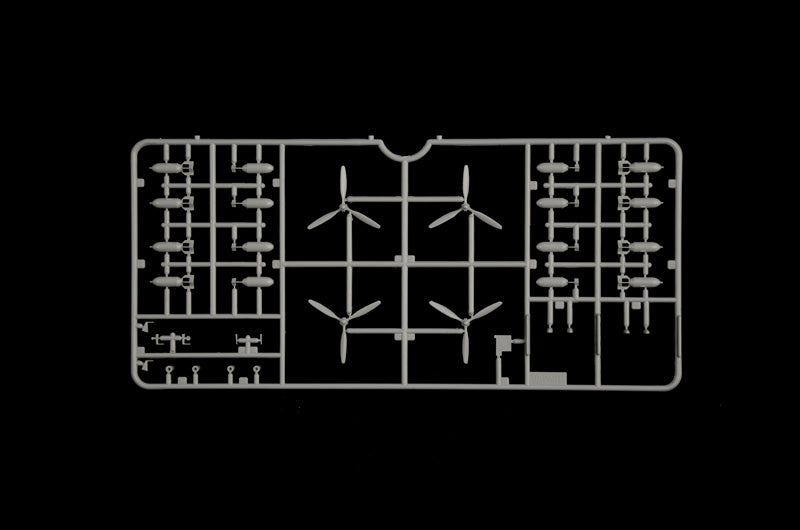


Italeri - B-17F Flyng Fortress
Italeri - B-17F Flyng Fortress
SKU:ITA1487
Regular price
$89.99 USD
Regular price
$44.99 USD
Sale price
$89.99 USD
Unit price
per
Shipping calculated at checkout.
Couldn't load pickup availability
Product features
Product features
Italeri 1:72 B-17F Flying Fortress – Model Kit to Assemble
At 1:72 scale, Italeri’s B-17F Flying Fortress measures 31.3 cm (12.3 inches) long and recreates one of the most iconic heavy bombers of World War II. The kit features detailed aircraft components, colorful assembly instructions, and decals for five different versions, offering modelers the opportunity to reproduce this legendary American bomber in a variety of historical markings.
Powered by four radial engines and designed to carry substantial bomb loads over long distances, the Boeing B-17 Flying Fortress became a central element of the United States Army Air Forces' strategic bombing campaign against Germany. Its distinctive silhouette, defensive machine-gun positions, and reputation for returning from heavily damaged missions made it one of the most recognizable aircraft of the conflict.
The B-17F represented an important stage in the aircraft's development, incorporating improvements to its operational capabilities, range, and defensive armament. Italeri’s scale model captures the character of this formidable aircraft and offers aviation enthusiasts an opportunity to explore the history of the bomber and the crews who flew it during some of the most demanding air campaigns of the Second World War.
The Flying Fortress – A Legend of World War II
The Boeing B-17 Flying Fortress was developed in the United States during the 1930s in response to the growing requirement for a modern, long-range heavy bomber. The aircraft was designed to fly considerable distances, carry a substantial bomb load, and defend itself against enemy fighters through a network of strategically positioned machine guns.
When the United States entered World War II in December 1941, the B-17 became an important component of American military aviation. It was deployed extensively in the European theater, where the United States Army Air Forces conducted large-scale bombing operations against German industrial facilities, transportation networks, military installations, and other strategic targets.
Unlike smaller tactical bombers, the B-17 was designed to undertake long missions deep into enemy-controlled territory. Its four-engine configuration provided the power and redundancy required for these demanding flights, while its defensive armament was intended to help protect the aircraft against interception by enemy fighters.
The Flying Fortress became famous for its ability to withstand considerable combat damage. Although it was never invulnerable, numerous aircraft managed to return to their bases despite suffering serious structural damage, engine failures, or damage to their control systems.
The B-17's reputation was built not only on its engineering but also on the experiences of the aircrews who operated it. Thousands of American airmen flew these aircraft over occupied Europe, facing anti-aircraft fire, enemy fighters, severe weather, and the physical demands of long missions at high altitude.
The B-17F – An Important Evolution
The B-17F represented a significant development of the original Flying Fortress design. Introduced into operational service in 1942, it incorporated improvements intended to enhance the aircraft's performance and suitability for the increasingly demanding bombing campaign over Europe.
One of the most important characteristics of the B-17F was its improved operational capability. The aircraft could carry a substantial offensive payload while maintaining the range required for long-distance missions. Its defensive armament also evolved to provide protection against attacks from different directions.
The B-17F was equipped with ten .50-caliber machine guns, distributed across defensive positions around the aircraft. These weapons were operated by crew members assigned to protect the bomber from enemy fighters approaching from the front, sides, above, or below.
The aircraft's defensive configuration reflected the harsh reality of daylight bombing operations. German fighter aircraft frequently attempted to intercept American bomber formations, while anti-aircraft artillery presented an additional threat over defended targets.
Despite these dangers, the B-17F became a familiar sight over Europe. Its combination of range, bomb-carrying capacity, and defensive firepower helped establish the Flying Fortress as one of the principal heavy bombers used by the United States Army Air Forces.
Italeri’s 1:72 scale B-17F model recreates this important version, making it an excellent subject for collectors interested in the development of American strategic bombing aircraft during World War II.
Four Engines. Heavy Bomb Load. A Formidable Mission.
The B-17 Flying Fortress was powered by four radial piston engines, a configuration that gave the aircraft the power necessary for long-distance operations while carrying bombs, defensive ammunition, fuel, and a full crew.
Its four-engine layout was one of the aircraft's defining characteristics. The engines were mounted along the wings, creating the unmistakable profile that helped make the Flying Fortress one of the most recognizable military aircraft in history.
The aircraft's primary offensive role was strategic bombing. Its internal bomb bay allowed it to carry bombs intended for industrial facilities, railway infrastructure, airfields, ports, and other military or strategic objectives.
Defensive machine guns were positioned throughout the aircraft to provide overlapping fields of fire. Depending on the position, crew members operated weapons from the nose, fuselage, waist, dorsal, and ventral defensive stations, as well as the tail.
The combination of heavy offensive payload and defensive armament made the B-17 a complex aircraft requiring coordination among its crew members. Pilots, navigators, bombardiers, radio operators, and gunners each performed essential tasks during long and often dangerous missions.
These characteristics make the B-17F particularly appealing to modelers. Its four engines, extensive glazing, large wings, and numerous defensive positions provide a wealth of recognizable details to reproduce and paint.
Strategic Bombing Over Europe
During World War II, the United States Army Air Forces conducted an extensive daylight bombing campaign against targets throughout German-occupied Europe and Germany itself. The B-17 became one of the principal aircraft employed in these operations, particularly by the Eighth Air Force based in Britain.
The objective of strategic bombing was to weaken the enemy's ability to continue fighting by attacking industrial production, transportation systems, fuel supplies, and military infrastructure. These missions required aircraft to travel long distances, maintain formation, and deliver their bomb loads over heavily defended targets.
Early American bombing operations over Europe exposed the dangers of daylight missions. German fighter interception and concentrated anti-aircraft fire could inflict severe losses, especially when bomber formations lacked sufficient fighter protection.
As tactics, escort capabilities, and operational experience improved, the effectiveness of American bombing operations evolved. Long-range fighter aircraft increasingly supported bomber formations, helping reduce their vulnerability during missions over enemy territory.
The B-17 became a symbol of these campaigns. Its size, defensive armament, and ability to carry bombs over long distances made it central to the American air war in Europe.
However, the aircraft's history also reflects the human cost of strategic bombing. Aircrews faced substantial risks on every mission, and many aircraft and crew members were lost during operations over heavily defended areas.
For military aviation enthusiasts, the B-17F represents more than an engineering achievement. It embodies the technological development, strategic ambitions, and human experiences that shaped the air war over Europe.
A Reputation for Strength and Survivability
The Flying Fortress acquired its enduring reputation partly because of the damage some aircraft survived during combat. Photographs of battered bombers returning to base with missing sections of their wings, damaged fuselages, or disabled engines became powerful images of the aircraft's durability.
Its robust structure and four-engine configuration could help an aircraft survive damage that might have forced other designs out of action. Nevertheless, the B-17 remained vulnerable to enemy fighters, anti-aircraft fire, and failures affecting critical flight systems.
Survivability depended on numerous factors, including the location of the damage, the aircraft's remaining power, the skill of the crew, and the conditions encountered during the return flight.
The Flying Fortress was therefore not indestructible, despite its nickname. Its reputation reflected the resilience of the design and the extraordinary circumstances under which its crews operated.
This combination of strength and vulnerability is part of what makes the B-17 such a compelling subject for historical modeling. A carefully finished model can represent the aircraft in factory-fresh condition or suggest the worn appearance of a bomber returning from repeated operational missions.
The B-17F in the European Theater
The B-17F saw extensive service during the critical period when American strategic bombing operations over Europe expanded in scale and intensity. Operating from airfields in Britain, bomber groups undertook missions against targets across occupied Europe and German territory.
These operations placed enormous demands on both aircraft and crews. Missions could last for many hours, exposing airmen to cold temperatures, high-altitude conditions, oxygen-system requirements, and the constant threat of enemy attack.
Bomber formations relied on disciplined flying and coordinated defensive fire. Maintaining formation was important for navigation, mission execution, and the concentration of defensive weapons against attacking fighters.
The B-17F was subsequently followed by the B-17G, which introduced a prominent chin turret equipped with additional machine guns to improve forward defensive coverage. The B-17G became the most numerous production version of the Flying Fortress.
Although later variants introduced further refinements, the B-17F remains an important version in the aircraft's development. It represents the period when the Flying Fortress was becoming one of the defining aircraft of the American air campaign over Europe.
Italeri’s model provides an opportunity to recreate this particular stage in the aircraft's history and display it alongside other aircraft from the Second World War.
A Distinctive Subject for Aircraft Modelers
The B-17F offers an excellent modeling subject thanks to its recognizable shape and the many details distributed across its airframe.
The four radial engines, large wings, glazed nose, and defensive gun positions create a distinctive appearance that separates the Flying Fortress from single-engine fighters and smaller tactical bombers.
Its extensive glazing is particularly important to the finished appearance. Careful attention to the transparent sections and surrounding frames can help emphasize the cockpit and crew compartments while preserving the aircraft's characteristic silhouette.
The large wing surfaces and fuselage also provide opportunities for careful painting and weathering. Modelers may choose to reproduce the appearance of a well-maintained aircraft or introduce restrained effects suggesting operational wear, exhaust staining, and exposure to demanding flying conditions.
The available decal options allow collectors to explore different aircraft markings and presentation styles. Each version can provide a distinct interpretation of the Flying Fortress and its service history.
Whether displayed as part of a collection of American aircraft, a Second World War aviation display, or a larger historical diorama, the B-17F makes an impressive centerpiece.
Kit Features and Specifications
Manufacturer: Italeri
Manufacturer's item number: 1487
Aircraft: Boeing B-17F Flying Fortress
Scale: 1:72
Finished length: 31.3 cm (12.3 inches)
Aircraft type: Four-engine heavy bomber
Historical period: World War II
Country: United States
Skill level: 3 – Intermediate
Decals: Markings for 5 versions
Instructions: Color assembly instructions
Suggested paints: Italeri provides recommended colors for finishing the model.
Figures: Not included.
Construction: Plastic model kit to assemble.
A Must-Have for World War II Aviation Collections
The B-17F Flying Fortress is an excellent choice for collectors interested in American military aviation, strategic bombing, and the history of the Second World War.
Its distinctive four-engine configuration, extensive defensive armament, and historic role over Europe make it instantly recognizable. The aircraft also provides an opportunity to explore the experiences of the crews who flew long-distance missions under exceptionally dangerous conditions.
At 1:72 scale, the Italeri kit offers a balance between display presence and manageable size. Its finished length of 31.3 cm makes it suitable for a dedicated aircraft display or a broader collection of historic military aircraft.
Whether you are expanding a World War II collection or looking for a classic heavy bomber to build and paint, the B-17F Flying Fortress represents one of the most significant aircraft of the Allied air campaign.
Assembly and Painting Information
This product is a plastic model kit that requires assembly and painting. It is supplied as an unassembled model and is not a finished display aircraft.
Paints, modeling glue, and tools are not included unless specifically stated by the manufacturer. Please consult the included color instructions for assembly guidance, recommended paints, and decal placement.
Please note: Figures are not included with this kit.
Recommended for modelers with some assembly experience. The manufacturer rates this kit at Skill Level 3.